


Fasteners
A fastener or fastening is a hardware device that mechanically joins or affixes two or more objects together. In general, fasteners are used to create non-permanent joints; that is, joints that can be removed or dismantled without damaging the joining components. Steel fasteners are usually made of stainless steel, carbon steel, or alloy steel. Other methods of joining materials, some of which may create permanent joints, include: crimping, welding, soldering, brazing, taping, gluing, cement, or the use of other adhesives. Force may also be used, such as with magnets, vacuum (like suction cups), or even friction (like sticky pads). Some types of woodworking joints make use of separate internal reinforcements, such as dowels or biscuits, which in a sense can be considered fasteners within the scope of the joint system, although on their own they are not general-purpose fasteners.
Advantages of Fasteners
Lower product weight
Several industries are now turning to lighter, more agile products to reduce manufacturing costs, improve their appearance and make objects easier to handle and use. Small screws are perfect for these items, as they meet the basic fastening requirements and lower the product’s weight.
Increased designing flexibility
Fastener screws give designers and engineers more options when creating products. For example, companies that manufacture electronic devices like laptops and tablets can make these items less expensive for consumers by using fasteners instead of welds and adhesives when attaching specific parts and components. Screws also make these items easier to repair.
Reduced waste
Many products require the assembling of multiple parts and components. Fasteners enable companies to complete the process with fewer materials, which generates less waste and lowers production costs. Manufacturers only need to create small, pre-drilled holes to accommodate screws, nuts and bolts to facilitate the final assembly.
Increased efficiency
One of the primary advantages of fasteners is that they can help to increase efficiency in a variety of applications. Fasteners can be used to quickly and easily connect two or more components, which can save a significant amount of time and effort when compared to traditional methods such as welding or bolting.


Why Choose Us
Our factory
Having been present for almost two decades, YASSIAN has always focused on customer satisfaction. Following our customers' requirements allowed us to create value for them in a true sense. YASSIAN started its operations in 2002 by offering Cutting Edges and Bucket Teeth at first. Now we are one of the famous manufacturer of Ground Engaging Tools parts in China.
Our product
Today, YASSIAN produces an extensive range of aftermarket replacement G.E.T. wear parts including Ground Engaging Tools, Cutting edges, Bucket teeth and adapters and various types of Bucket Wear Parts under one roof which are suitable for many kinds of construction and mining machines like Excavator, Motor grader, Bulldozer, Scraper etc. We are using raw material from the best steel plant in China.We also have very professional manufacturing facilities in each production process and strict quality control system to provide our clients the strongest products.
Quality control
QC Inspectors then check all dimensions and mechanical performance, before our final inspectors perform a final check on everything(dimension, holes distance, hardness, etc.)and ensure all products are ready to be packed and delivered. All products are required to fall within some of the stricter industry tolerances and all QC testing is done in addition to the battery of tests that occur regularly in our Research & Development department.
Our service
We have a dedicated team of loving people who listen to our customers' queries 7 days a week. We always love to get feedback and continue improving customer experience. There is a 24-months quality warranty for all YASSIAN products and we can provide free replacement if the products are broken under abnormal conditions. We will help you to explore your market if you become our business partner. And welcome to be our sales agent.
Common Fasteners Head Styles
Flat head fasteners
Ideal for applications where aesthetics are a priority, flat head fasteners sit flush with the surface, offering a clean appearance.
Round head fasteners
With a rounded top, round head fasteners provide a larger bearing surface, suitable for sheet metal or thin plastic assemblies.
Pan head fasteners
Pan head fasteners combine a slightly flattened top with a larger bearing surface, offering a streamlined appearance for aesthetic applications.
Socket head fasteners
Designed for high torque applications, socket head fasteners are driven with a hex key, reducing the risk of cam-out.
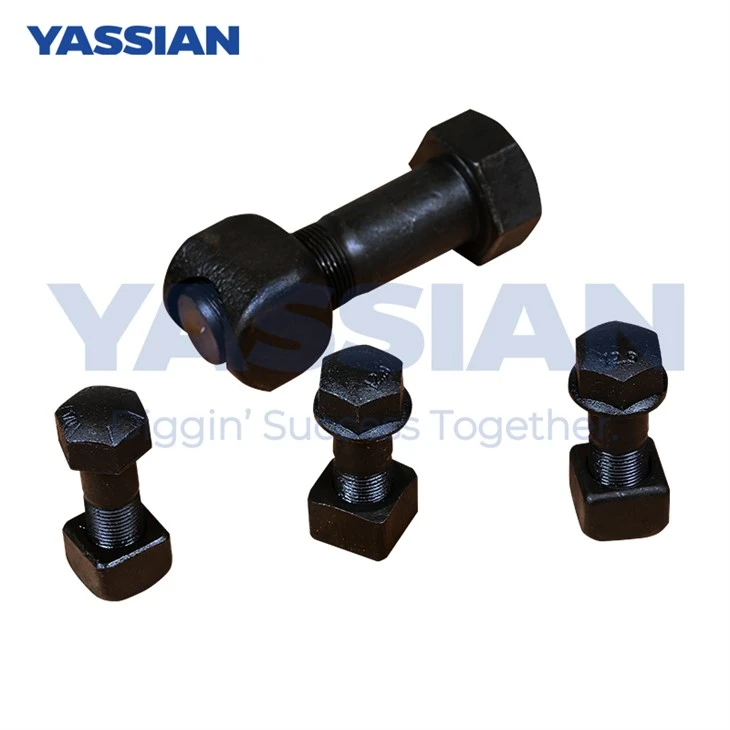
Hex head fasteners
Known for their high torque capacity, hex head fasteners are easily driven with a spanner or wrench, ideal for heavy-duty applications.
Square head fasteners
Offering increased wrenching area and reduced risk of rounding off, square head fasteners are used in high torque applications.
Flange head fasteners
Integrating a flange for a larger bearing surface, flange head fasteners distribute clamping force without damaging the material.
Wing head fasteners
Featuring protruding "wings" for hand tightening, wing head fasteners are suitable for applications requiring frequent adjustments.
T-slot fasteners
Designed for T-slotted aluminium extrusions, T-slot fasteners provide a secure and adjustable connection for framing and guarding systems.
Different Uses for Fasteners
Vehicle assembly
You can find small fasteners throughout an automobile, including under the hood, in the suspension system and wherever else there is a connection between two parts or components, such as lock nuts on tires.
Picture hanging
Small fasteners are prevalent in virtually every area with decorations hanging on the walls. Homeowners and other decorators use them when placing pictures and for other essential purposes.
Building and construction
A metal fastener can serve multiple purposes to ensure materials stay together during construction projects.
Furniture assembly
Furniture makers rely on fasteners when assembling their products and preparing them for sale to customers.
Cabinet installation
Home improvement contractors need an assortment of fasteners when working on kitchen cabinet installation and renovation projects.
Electronics manufacturing
Fasteners play a prominent role in the production of electronic machinery, components and goods used in the workplace and at home.
Wall installation
Workers use anchors in tandem with screws to create firm mounts on drywall panels.
Roofing projects
Roofing nails and framing nails are essential when installing new roofs or conducting repairs and maintenance on existing structures.
Woodworking
Not all fasteners are for holding two metal objects together. Carpenters and other construction and building professionals use wood screws to form solid connections between parts made of plywood and other wood materials.
Flooring installation
Companies require flooring nails when installing some types of products in homes, office buildings, factories, warehouses and commercial and retail establishments.

How Fasteners are Made
Machining
The machining process is a method for deforming metals to create parts and components. By cutting, drilling, turning, milling, and grinding a piece of metal, it can be deformed and shaped to fit a desired pattern or form. Unlike molding and casting, machining is a process that works the metal at room temperature or slightly above. Though the metal may heat up due to friction, heat is not a part of the process. Machining begins with a round or hexagonal piece of metal. During the machining process, the metal piece, the workpiece, is threaded and shanked to meet the required geometry of the final part. Machining can involve several processes at once, which are performed on a computer numerical control (CNC) machine; this helps in speeding up the process.The benefits of machining include precision, exceptional tolerances, and the ability to produce complex geometries. It is a time consuming process that is ideal for short runs of minimal quantities.
Cold forming
Of the various methods for creating fasteners, cold forming, or cold roll forming, is the most common due to its speed and reduction of waste. Like machining, it is performed at or near room temperature to produce large quantities of fasteners in a fast, efficient, consistent, and cost effective way. Cold forming begins with a coil of wire that is processed, straightened, and sheared to the length required by the final part. The prepared pieces are fed into a rolling machine to complete the forming process and add intricate and precise details. The pressure applied to the workpiece maintains the original grain structure of the metal, which improves the tensile strength of the fastener. The types of cold forming are upsetting or heading, extrusion, and rolling. In the upsetting process, the workpiece is upset at one end to increase the area's cross section. With cold forming extrusion, compressive force is applied that causes the metal to produce deformation heat; this force can be applied at various angles to the workpiece. Cold roll forming also applies pressure to the workpiece to achieve the desired shape.
Hot forging
Hot forging is used when fasteners cannot be produced using machining or cold forming. A key part of hot forging is the heating of the workpiece. In the heating process, the workpiece is heated to its recrystallization temperature, which can be as high as 1200° C or 2192° F. The temperature at which the metal is heated allows it to maintain its deformed shape as it cools.During the forming and shaping process, the grain structure of the metal is broken down and homogenized into a finer grain, a process that enhances its strength, ductility, and toughness. Since hot forging produces very little scrap and waste, it is one of the most efficient metal forming methods.
Stamping
Stamping is a cold forming process that deforms a sheet of metal using a stamping press and is similar to blanking and piercing. Stamping can be a single one step process or have multiple steps or stages depending on the complexing of the part being produced. One of the most common types of fastener tools produced by stamping are washers of all types and configurations.Stamping can be used for any type of production run with high volume processes using coils of metal sheets fed into the stamping press.
Know the application
The types of fasteners you use will always depend on the requirements of your application. You have to consider if your fastener will fit. The design of the fastener can be vital in knowing the amount of torque it can take. You may need a very long flange bolt to hold several components of your parts. Also, you need to consider leaving some threads of the fastener out. This is to ensure the safety of the material and personnel. Sometimes, you may find more than one type of fastener working.
Select the right thread
Thread selection is another important factor when choosing a fastener. Threads are crucial parts of an application. They may be fine (unf), coarse (unc), or eight-thread. Coarse threads ensure the quicker assembly of components. On the other hand, fine threads may take longer to assemble. This is due to the number of revolutions they need to travel the distance. The advantage of fine over coarse threads is that they offer better thread engagement. They also ensure a more secure connection for accommodating greater tension in the connection. Regardless of your option, either can be very beneficial. All you need to do is choose the thread to offer the best load-handling capabilities.
Consider the materials of construction
Several different materials are used in making mechanical fasteners. The most used material is carbon steel. This is due to its wide range of strength and workability properties. Other materials include alloy steel and stainless steel. Alloy steel bolts don’t usually come plated.They are very strong but quite brittle. On the other hand, stainless steel can have specific properties for special use. They are perfect in high moisture areas, e.G., water plants. They are also good for use in areas where there may be chemical exposure. Bronze, brass, and aluminum are also used occasionally. They are highly corrosion resistant. The best types of fasteners come with hard materials to eliminate the danger of thread stripping or galling. Pressure may build up between thread surfaces in contact. This increases friction and may cause the fusion or seizing of the fastener.
Type of exposure for the fastener
You must also consider the temperature you will expose the fastener to before selection. Extreme temperature changes can lead to the expansion and contraction of fastened joints. This can lead to a loose connection. Hence, the need for a fastener that can meet the temperature requirements. The level of vibration is another important consideration. A prevailing torque locknut may be the right option in areas of high vibrations. This will prevent the fasteners from loose vibration.
Your Guide to Good Fastener Maintenance
Avoid galling through lubrication
Galling is a type of abrasive wear which occurs when metal materials rub together and is often attributed to poor lubrication. Over time thread galling can occur, particularly with stainless steel or aluminium fasteners. When left unattended, galling can cause fasteners to seize or even suffer breakages, and if a fastener has seized it can be extremely difficult to remove. Through regular lubrication or the use of anti-seize compounds this worst-case scenario can be avoided.
Reduce exposure to contaminants
It’s always a good idea to evaluate any possible contaminants that your fasteners may be exposed to such as salt water, adverse weather or soil. These factors can speed up the process of uniform corrosion, galvanic corrosion and rust. Regularly check your applications to ensure there are no new factors that could impact the longevity of your fixing, such as an increase in metallic dust in the atmosphere or a new location.
Consider restoration
Although you may have selected the best coating for your fasteners pre-assembly, corrosion is a natural occurrence that can inevitably appear over time. A new coat or spray of paint can help add a new barrier of protection and, if it’s of importance to you, it can also help improve the visual appearance of your overall application.
Use the correct tools
For stainless steel applications, iron contamination from incorrect tools can be a common incident. When tools that contain iron are used on stainless steel fasteners this causes iron fallout that leads to rust. Despite this regular problem, iron contamination is ultimately avoidable by simply opting for chrome vanadium steel drivers and tools.
Keep to a cleaning routine
It may seem simple, but a regular cleaning routine can go a long way in extending the life of your fasteners. The previously mentioned issue of contaminants can be rectified with cleaning, by removing the build-up of dust and debris before it can start causing corrosion or rust.
Our factory
Having been present for almost two decades, YASSIAN has always focused on customer satisfaction. Following our customers' requirements allowed us to create value for them in a true sense. YASSIAN started its operations in 2002 by offering Cutting Edges and Bucket Teeth at first. Now we are one of the famous manufacturer of Ground Engaging Tools parts in China. We strengthen our business operations, focus more on research and development and gradually transformed into be a bigger company to serve more customers from 100+ countries and set foot on the global stage. Now we can supply a wide range of aftermarket parts with 15000+ different part number. Today, YASSIAN produces an extensive range of aftermarket replacement G.E.T. wear parts including Ground Engaging Tools, Cutting edges, Bucket teeth and adapters and various types of Bucket Wear Parts under one roof which are suitable for many kinds of construction and mining machines like Excavator, Motor grader, Bulldozer, Scraper etc. We are using raw material from the best steel plant in China.We also have very professional manufacturing facilities in each production process and strict quality control system to provide our clients the strongest products.


Video
Certificate
