


Selecting the right loader bucket is not simply a matter of choosing the largest capacity or the heaviest construction. A bucket must match the density, abrasiveness, particle size and handling characteristics of the material. Otherwise, the loader may suffer from poor bucket fill, excessive wear, increased fuel consumption or even overloading.
Among the most common wheel loader bucket types are the general purpose loader bucket, rock loader bucket and light material loader bucket. Although they may look similar, they are designed for very different working conditions.
This loader bucket comparison explains the differences in steel thickness, bucket structure, teeth, cutting edges, wear protection, capacity and suitable materials. It also explains where a heavy duty loader bucket fits into the selection process.
Quick Loader Bucket Comparison
|
Feature |
General Purpose Bucket |
Rock Bucket |
Light Material Bucket |
|
Main purpose |
General loading and earthmoving |
Loading dense and abrasive rock |
Moving low-density bulk materials |
|
Typical materials |
Soil, sand, gravel and crushed stone |
Blasted rock, granite, ore and quarry stone |
Grain, snow, fertilizer and woodchips |
|
Capacity |
Medium |
Usually smaller for the same loader class |
Usually larger |
|
Empty weight |
Medium |
Higher |
Controlled to preserve payload |
|
Teeth |
Optional |
Commonly installed |
Usually not required |
|
Cutting edge |
Flat edge, bolt-on edge or teeth |
Heavy base edge with teeth and adapters |
Straight or bolt-on cutting edge |
|
Wear protection |
Moderate |
Extensive and application-specific |
Limited |
|
Best applications |
Construction and general material handling |
Quarrying, mining and severe earthmoving |
Agriculture, recycling and snow removal |

Actual specifications vary by bucket manufacturer, loader model and operating conditions. Therefore, this table should be used as a general selection guide rather than a replacement for machine-specific calculations.
What Is a General Purpose Loader Bucket?
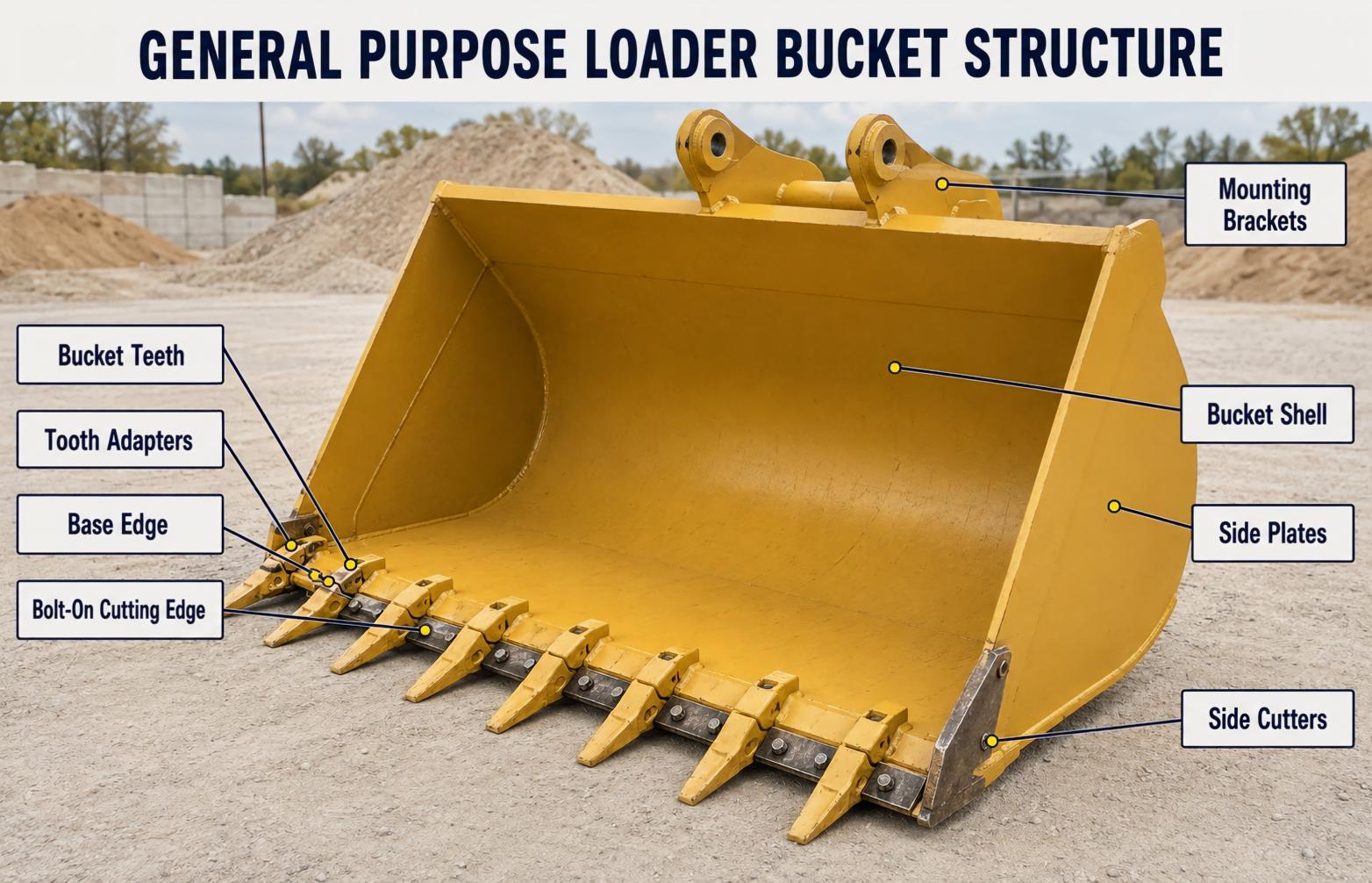
A general purpose loader bucket is designed to provide a practical balance between capacity, bucket weight, penetration and durability. It is the most versatile choice when a wheel loader must handle several materials instead of performing one specialized task.
The bucket normally has a moderately reinforced shell, a general loading profile and wear-resistant steel in the areas most exposed to contact with the material. Depending on the application, it may use a straight base edge, a replaceable bolt-on cutting edge or weld-on adapters with bucket teeth.
Bucket teeth improve penetration when working in compacted soil, clay or material banks. A straight cutting edge is often better for stockpiling, cleaning level surfaces and handling loose processed materials.
Typical applications include:
Loose soil and clay
Sand and gravel
Crushed stone
General aggregate
Construction-site material
Stockpile loading
Caterpillar describes general purpose buckets as an all-around option for handling materials such as sand, gravel, soil and crushed stone. This makes them suitable for contractors and rental fleets that frequently move between different jobs.
However, a standard general purpose bucket is not the best choice for continuous loading of large blasted rock. In a quarry or highly abrasive environment, its floor, side plates, cutting edge and corners may wear much faster than those of a dedicated rock bucket.
What Is a Rock Loader Bucket?
A rock loader bucket is designed for dense, abrasive and impact-heavy materials. It normally has more reinforcement in critical areas than a standard general purpose bucket, but a well-designed rock bucket is not simply covered with as much steel as possible.
Its wear protection should be concentrated in the areas that experience the greatest impact or sliding abrasion. Common structural and wear components include:
A reinforced bucket shell
A thicker base edge
Heavy-duty bucket teeth
Weld-on tooth adapters
Reinforced side plates
Heavy-duty side cutters
Bottom wear plates or wear strips
Side wear plates
Heel plates or heel shrouds
Bucket teeth and adapters help the cutting edge enter compacted or interlocked rock. Side cutters protect the front side edges and may also improve penetration. Bottom and heel protection reduce wear as material flows through the bucket and as the bucket moves across the ground.
Typical applications for a rock loader bucket include:
Blasted granite or basalt
Quarry stone
Large aggregate
Hard and abrasive rock
Ore
Demolition debris
Severe mining materials
Compared with a general purpose bucket, a rock bucket often has a smaller nominal capacity for the same loader class. This is partly because rock has a higher density and partly because the reinforced bucket itself weighs more. Reducing bucket capacity can help keep the total loaded weight within the loader's safe operating limits.
Rock bucket selection should also consider the difference between impact and abrasion. Large, irregular rocks create repeated impact around the teeth, corners and side plates. Fine, abrasive particles create continuous sliding wear across the floor and inner surfaces. The correct protection layout depends on which type of wear dominates the application.
What Is a Light Material Loader Bucket?

A light material loader bucket is a high-volume bucket designed for materials with low loose density. It is usually taller, deeper or wider than a standard bucket, allowing the loader to move more material in each cycle without exceeding its permitted payload.
John Deere identifies woodchips, sawdust, snow, grain and fertilizer among the typical applications for a light material bucket. Volvo also describes this bucket type as a large-capacity solution for loosely packed materials such as coal, compost, grain and woodchips.
Common light material bucket features include:
Large internal volume
Relatively lightweight construction
A high back and deep floor
Good material-retention characteristics
A straight or bolt-on cutting edge
Limited wear protection compared with a rock bucket
A profile designed for rapid filling and clean dumping
Light material buckets usually do not require aggressive rock teeth because their materials are loose and easy to penetrate. A smooth cutting edge also helps when collecting material from paved yards, warehouse floors or agricultural storage areas.
Their larger capacity must not be misunderstood as permission to carry any material. Filling a light material bucket with wet sand, ore, broken concrete or dense rock can overload the machine before the bucket appears full. This may affect stability, tires, lift arms, hydraulic components and overall safety.
How Capacity, Density and Bucket Weight Work Together

Bucket capacity alone does not determine how much material a loader can safely move. The expected payload should be estimated using:
Estimated Material Payload = Bucket Capacity × Fill Factor × Loose Material Density
The result must then be checked against the loader's allowable operating load. The weight of the bucket, quick coupler, teeth, side cutters, wear plates and any hydraulic mechanism must also be included.
A useful relationship is:
Available Material Payload = Permitted Load − Bucket and Attachment Weight
This explains why additional reinforcement is not always beneficial. Excessive wear plates can increase empty weight and reduce the amount of material available in each load. The goal is to provide adequate protection for the application while maintaining efficient payload and bucket fill.
Where Does a Heavy Duty Loader Bucket Fit?
The term heavy duty loader bucket can cause confusion because it usually describes a construction or duty level rather than one specific bucket application.
For example, a manufacturer may offer both a standard and a heavy-duty general purpose bucket. The heavy-duty version may have a stronger floor, thicker cutting edge, reinforced side plates or additional wear protection for frequent operation in harsh conditions.
A rock bucket is normally heavy-duty by nature, but it is also shaped and equipped specifically for rock penetration and protection. Therefore, a heavy-duty general purpose bucket and a rock bucket are not automatically the same product.
Similarly, some high-volume buckets used for refuse or recycling may have heavy-duty reinforcement while still being designed for relatively low-density material.
The correct question is not simply, "Do I need a heavy bucket?" It is:
What material will the bucket handle?
How dense is the material?
Is the main problem impact, abrasion or both?
How many hours will the bucket operate each day?
Which areas are wearing fastest?
How much attachment weight can the loader safely carry?
How to Choose the Right Loader Bucket
Start by identifying the material's loose density, maximum particle size and moisture level. "Sand" is not precise enough because dry sand and wet sand can place very different loads on the machine. The same applies to soil, coal, aggregate and demolition waste.
Next, evaluate how difficult the material is to penetrate. Compacted soil and rock banks may require teeth, while loose grain or snow can be handled more efficiently with a straight cutting edge.
You should also confirm:
Loader brand and model
Rated payload and tipping-load limits
Required bucket capacity and width
Pin-on or quick-coupler connection
Pin diameter and mounting dimensions
Material density and fill factor
Required teeth and cutting-edge configuration
Impact and abrasion levels
Preferred wear-protection layout
For mixed construction work involving soil, gravel and loose aggregate, a general purpose bucket is usually the most flexible solution. For blasted rock, ore and quarry applications, a properly reinforced rock bucket provides better protection and penetration. For grain, fertilizer, snow, woodchips and other low-density bulk materials, a light material bucket can increase the volume moved per cycle.
Common Loader Bucket Selection Mistakes
One common mistake is choosing a bucket only by its cubic capacity. A large bucket may improve production with light materials but create an overload risk with dense materials.
Another mistake is assuming that thicker steel always means longer service life. Steel quality, bucket geometry, weld design and the location of wear protection are just as important as thickness.
Other common errors include using a general purpose bucket continuously in blasted rock, using a light material bucket for wet sand, ignoring the weight of a quick coupler and installing wear plates in areas that do not experience significant abrasion.
These mistakes increase operating costs without necessarily improving bucket performance.
Final Thoughts
The best loader bucket is the one matched to the material, machine and operating environment.
A general purpose loader bucket offers versatility for everyday construction and material-handling work. A rock loader bucket provides the penetration, structural reinforcement and replaceable wear protection needed for quarrying and mining. A light material loader bucket uses greater capacity to improve productivity with grain, snow, fertilizer, woodchips and other low-density materials.
Before ordering, provide your bucket manufacturer with the loader model, mounting dimensions, material density, required capacity and working conditions. At YASSIAN, we can help review the application and recommend suitable bucket teeth, adapters, cutting edges, side cutters and wear-protection components for different loader bucket designs.


